Blog
HDB-to-condo upgrade in Singapore: How Much Cash You Need
Fendy Lee
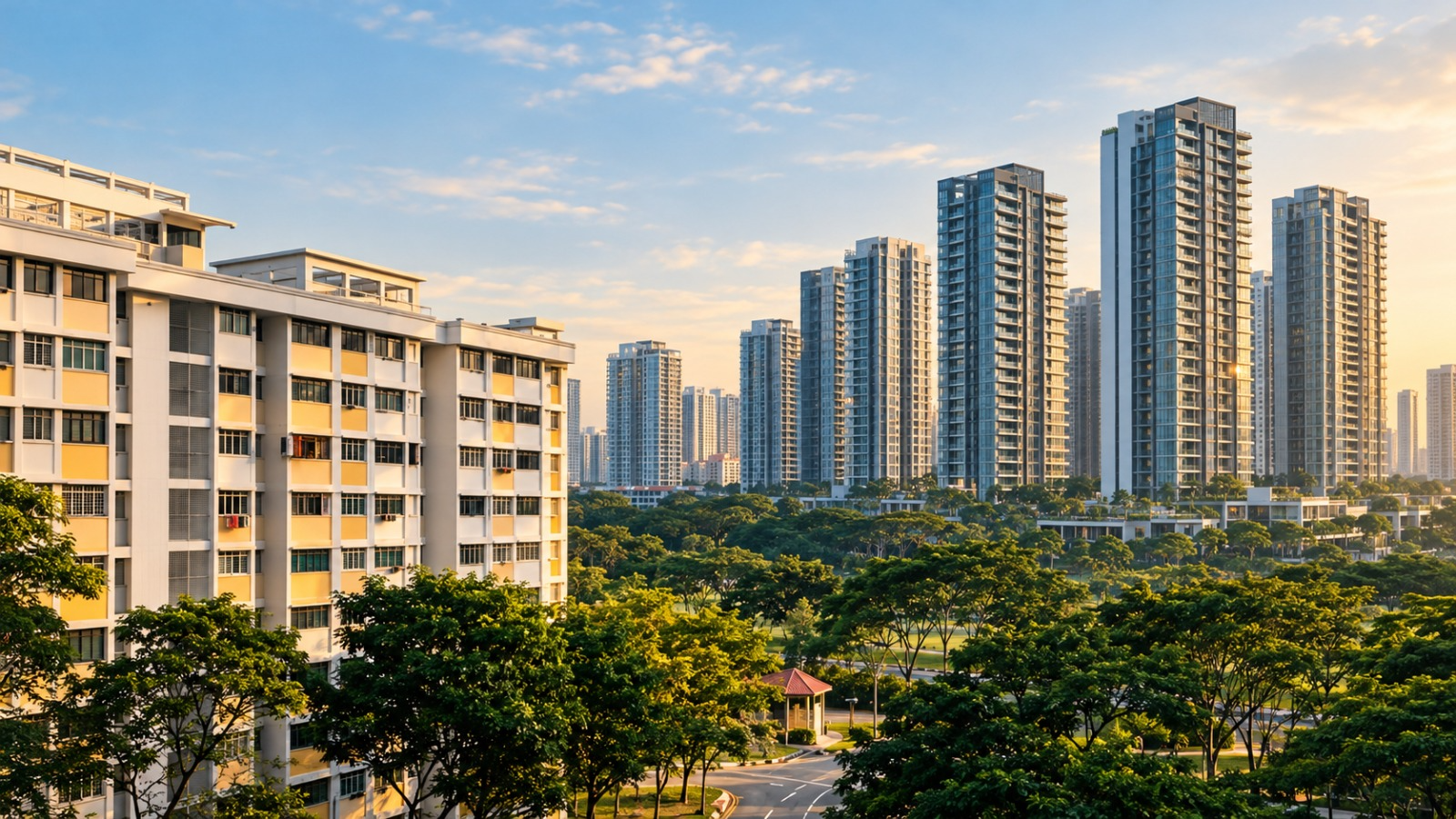
Your HDB sells for $900,000. Does that mean you have $900,000 for a condo? Not even close. The loan, the CPF refund, stamp duty, and legal costs all come out before you see a cent.
That's why the cost of upgrading from an HDB to a condo in Singapore surprises so many families. The real question isn't the condo's price. It's how much cash and CPF you'll have after the sale and whether your income can carry the new loan. Fendy Lee, a Singapore property agent at Huttons, helps upgraders check both before they sign anything. Below, you'll see the full picture with 2026 rules and worked examples at $1.2 million, $1.5 million, and $1.8 million.
Quick Answer: What an HDB to Condo Upgrade in Singapore Needs
If you sell your HDB first and then buy, you need 25% of the condo's price as a down payment, with at least 5% of it in cash. Stamp duty and legal fees go on top. For a $1.5 million condo, that comes to about $422,600 in cash and CPF combined.
If you're searching for how much cash to upgrade from an HDB to a condo, the floor is $75,000 in actual cash on that $1.5 million purchase. Most families need more once stamp duty, legal fees, renovation, and a rent buffer are counted. The bank loan covers the rest, and your income decides how big it can be.
Here's how the upfront money grows with the price.
| Condo price | 5% cash | 20% cash or CPF | Stamp duty (BSD) | Legal fees (assumed) | Total upfront |
|---|---|---|---|---|---|
| $1,200,000 | $60,000 | $240,000 | $32,600 | $3,000 | $335,600 |
| $1,500,000 | $75,000 | $300,000 | $44,600 | $3,000 | $422,600 |
| $1,800,000 | $90,000 | $360,000 | $59,600 | $3,000 | $512,600 |
This assumes your HDB sale has been completed before you buy (so no ABSD), a 75% bank loan and a 30-year tenure. It leaves out renovation, moving costs, and rent.
Can You Upgrade Yet? Check Your MOP and Ownership First
Before planning your HDB-to-condo upgrade, check whether you have completed your flat's Minimum Occupation Period (MOP). For most Standard HDB flats, the MOP is five years, while Plus and Prime flats generally have a ten-year MOP. The period usually starts from the date you take possession of the flat, but time spent not occupying the flat may be excluded. You can check your MOP status through HDB's online services.
During the MOP, flat owners, their spouses, and listed occupiers cannot acquire private residential property in Singapore or overseas. Once the MOP is fulfilled, the rules depend on your household's ownership status. A household with at least one Singapore Citizen flat owner can generally retain its HDB flat after acquiring private residential property, subject to HDB's conditions. If all flat owners are Singapore Permanent Residents (PRs), they must notify HDB before proceeding and sell their HDB flat within six months of acquiring a private residential property in Singapore.
If you have not completed your MOP yet, use the time to review your finances, estimate your potential sale proceeds, and understand your next purchase options. Our guide to selling your HDB MOP Flat in 2026? What You Must Know can help you understand the selling process and plan your next steps.
Your HDB Sale Doesn't Equal Your Cash
Your sale price is not the money you take home. Three things leave first: your outstanding HDB loan, your CPF refund, and the cost of selling. What's left is your cash proceeds.
What a 4-Room and a 5-Room Sale Might Leave You
These examples use rounded sale prices for illustration: $630,000 for a 4-room HDB flat and $740,000 for a 5-room flat. The loan balances, CPF refunds, and selling costs are hypothetical. Your actual proceeds will depend on your financial situation.
- 4-room HDB flat
- Sale price: $630,000
- Outstanding housing loan: $160,000
- CPF refund: $270,000
- Selling costs: $12,000
- Estimated cash proceeds: $188,000
- 5-room HDB flat
- Sale price: $740,000
- Outstanding housing loan: $210,000
- CPF refund: $320,000
- Selling costs: $14,000
- Estimated cash proceeds: $196,000
- Estimated CPF Ordinary Account balance after the sale
- 4-room flat: About $310,000, assuming an existing balance of $40,000.
- 5-room flat: About $370,000, assuming an existing balance of $50,000.
These figures show that even though a 5-room HDB flat sells for $110,000 more than a 4-room flat, the estimated cash proceeds are only $8,000 higher. This is because outstanding loans, CPF refunds, and selling costs affect how much cash remains after the sale. CPF refunds generally return to your CPF account rather than becoming cash in hand. These examples are for illustration only, as your actual proceeds will depend on your sale price, loan balance, CPF refund, and transaction costs.
The CPF Refund After Selling HDB
The CPF money you used on the flat goes back into your own Ordinary Account, along with the interest it would have earned at 2.5% a year. It isn't lost. It also isn't cash. You can use it again for the condo, but only within CPF limits: up to the lower of the condo's price or its valuation, and up to 120% of that amount in total if you meet the retirement sum rules.
If your sale proceeds can't cover the full refund, you don't need to top up the gap in cash, as long as the flat is sold at market value.
Cash Over Valuation Can Help When You Sell
Buyers and any trusted HDB buying agent in Singapore acting for them should check recent resale transactions in your town before making an offer. Price against those. If a buyer agrees to pay above the bank's valuation, the extra is called cash over valuation (COV), and it's paid in cash. It can lift your take-home. Don't plan around it.
The Full Cost of Your Upgrade
Plan for three buckets at signing: the down payment, stamp duty, and legal fees. The costs after you move in come later in this guide.
Down Payment: How the 5% and 20% Split Works
The condo down payment in Singapore is 25% of the price or the bank's valuation, whichever is lower, when you have no other housing loan running. The first 5% is the minimum cash down payment, and it can't come from CPF. The other 20% can be cash, CPF Ordinary Account savings, or a mix, within the CPF limits above.
If the price is higher than the bank's valuation, you pay the gap in cash on top. More on that shortly.
Stamp Duty and down payment
Buyer's Stamp Duty (BSD) is charged on a sliding scale: 1% on the first $180,000, 2% on the next $180,000, 3% on the next $640,000, 4% on the next $500,000, 5% on the next $1.5 million, and 6% beyond that. These rates have been in effect since 15 February 2023.
That works out to $32,600 on a $1.2 million condo, $44,600 on a $1.5 million condo, and $59,600 on a $1.8 million condo. BSD can usually be paid from your CPF Ordinary Account within the limits, but after the refund, many upgraders find they pay part of it in cash. Legal fees often run a few thousand dollars, and the examples here assume $3,000.
These sit on top of the down payment, so the HDB-to-condo upgrade cost at signing is higher than 25% of the price. Each extra $300,000 on the condo adds roughly $87,000 to $90,000 of upfront money. That steady climb is typical of an HDB-to-condo upgrade in Singapore.
Can Your Income Support the Loan?
The bank decides how much you can borrow, and the rule that bites hardest is the Total Debt Servicing Ratio (TDSR). It caps all your monthly debt payments at 55% of your gross monthly income. That includes the new home loan, car loans, credit cards, personal loans, and any housing loan still running. Banks must also test your new loan at a stress rate of at least 4% a year, even if the rate you'll really pay is lower. Private condos aren't subject to the Mortgage Servicing Ratio that applies to HDB loans.
Here's what that looks like on a 75% loan over 30 years, with no other debts.
- $1.2 million condo: $900,000 loan, about $4,297 a month, so a gross income near $7,812 a month.
- $1.5 million condo: $1,125,000 loan, about $5,371 a month, so a gross income near $9,765 a month.
- $1.8 million condo: $1,350,000 loan, about $6,445 a month, so a gross income near $11,718 a month.
If your real rate is lower, say 2.5%, the actual instalment on the $1.125 million loan would be nearer $4,445. The bank still tests you at the higher rate.
Three things can shrink these numbers. Other debts count. Banks may discount bonuses and variable income. And a loan longer than 30 years, or one that runs past age 65, drops the loan limit from 75% to 55%. Treat these figures as a planning estimate, not a loan approval. The free Sell 1 Buy 2 Planner on this site is a good place to sketch your own figures first.
Sell HDB First or Buy Condo First?
Selling first is cheaper upfront and simpler. Buying first costs far more upfront, but you move only once. The right pick depends on your cash, your loan room, and how you handle a deadline.
How ABSD Affects Your HDB-to-Condo Upgrade
If you buy a condo while still owning your HDB flat, Additional Buyer's Stamp Duty (ABSD) may significantly increase your upfront costs. For a Singapore Citizen buying a second residential property, the ABSD rate is 20%. On a $1.5 million condo, that amounts to $300,000, payable alongside the applicable Buyer's Stamp Duty (BSD). Stamp duty deadlines are strict, so confirm the payment date with your conveyancing lawyer.
Some married couples may qualify for an ABSD refund when upgrading. Generally, the couple must jointly purchase the replacement property, at least one spouse must be a Singapore Citizen, and all applicable remission conditions must be met. For a completed condo, the existing residential property must generally be sold within six months of the purchase date. For an incomplete property, the deadline is six months from the earlier of the issue of its Temporary Occupation Permit (TOP) or Certificate of Statutory Completion (CSC). The refund application must also meet IRAS's deadline and eligibility requirements.
Selling your HDB before buying the condo may help you avoid ABSD on the new purchase, depending on your ownership circumstances. IRAS determines property ownership and purchase dates using specific legal milestones, so ask your conveyancing lawyer to confirm the timing before committing to either transaction.
Loan Limits Change Too
With no housing loan running when you take the condo loan, banks can lend up to 75% with 5% in cash. With an HDB loan still running, the limit drops to 45%, and the minimum cash rises to 25%. On a $1.5 million condo, that's a loan of $1,125,000 versus $675,000. If your flat is fully paid, buying first can keep the 75% limit, but the ABSD still applies.
Here's the same $1.5 million condo both ways.
| Sell first | Buy first (HDB loan running) | |
|---|---|---|
| Bank loan limit | 75% ($1,125,000) | 45% ($675,000) |
| Downpayment | $375,000 | $825,000 |
| BSD | $44,600 | $44,600 |
| ABSD paid upfront | $0 | $300,000 (refundable if you meet the rules) |
| Legal fees (assumed) | $3,000 | $3,000 |
| Total upfront | $422,600 | $1,172,600 |
| Where you live | May need temporary housing | One move |
| Main risk | Finding the condo fast | Selling within the deadline |
The buy-first route needs about $750,000 more upfront. On a resale condo, plan to pay the ABSD in cash first, and ask your lawyer whether any of it can be reimbursed from CPF.
Do You Need a Bridging Loan When Upgrading?
A bridging loan can help HDB upgraders cover the short-term funding gap between purchasing a condo and receiving the proceeds from their HDB sale. However, it comes with interest and other potential costs, so it is important to assess the repayment terms before applying. If you coordinate your HDB sale and condo purchase carefully, you may be able to avoid needing a bridging loan altogether.
Resale Condo, New Launch or EC?
A resale condo lets you move in sooner, and your six-month ABSD clock starts at purchase. A new launch is paid in stages and can take years to finish, but the clock starts at TOP or CSC, which gives you more time to sell. An EC is a different route with its own eligibility rules, so check those separately.
Should You Sell or Keep Your HDB Flat?
If you're a Singapore citizen, you may keep your HDB after the MOP and still buy a condo. Many upgraders sell anyway, because keeping the flat is expensive.
You'd pay ABSD at 20% and not get it back, since the refund depends on selling in time. A running HDB loan drops your condo loan limit to 45% and counts toward the TDSR. And if you move out and rent the flat, HDB's rental rules apply, and the flat loses owner-occupier property tax rates.
Keeping can make sense when you hold a large cash buffer and have a clear reason, such as housing family members. If your goal is simply a better home, selling is usually cleaner. PRs don't get the choice. They must sell within six months of buying private property.
Hidden Costs: Valuation Gaps, Maintenance Fees, and Renovation
Some costs don't show up in the down payment math. They still hit your bank account.
- Valuation gap. Banks lend, and CPF pays, against the lower of the price and the bank's valuation. If you agree to pay more than the valuation, you cover the difference in cash. A $50,000 gap means $50,00down payment. Ask for an indicative valuation before you exercise the option.
- Monthly fees. Condo maintenance fees are a bill that HDB conservancy charges never prepared you for. They run from a few hundred dollars a month in a modest project to much more, where the facilities list is long.
- Renovation and moving. Costs swing widely with how much you keep. Get quotes instead of trusting a figure you saw online.
- Temporary housing. If you sell first and buy a new launch, you'll rent for the years it takes to build. Even a resale purchase can leave a gap of a couple of months.
- Instalments. Your CPF Ordinary Account can pay the monthly instalment, but only up to the withdrawal limit. After that, instalments come from cash.
A Simple Upgrade Timeline
The dates that matter most are the ones set by law, not by your agent or your bank. Here's the sequence for a sell-first plan.
- Confirm your MOP end date. Plus and Prime flats have been running for ten years.
- Get your HDB loan payoff and CPF refund figures. The refund includes 2.5% interest.
- Get bank approval in principle. Do this before paying any option fee.
- List and sell the HDB flat. Price it against recent resale transactions.
- Complete the HDB sale. The loan and CPF are repaid before you get cash.
- Buy the condo and pay the option fee. It's often 1% of the price, paid in cash.
- Pay stamp duty and legal fees. The condo loan starts. Keep proof of every payment.
- Collect keys, renovate, and move. Keep a rent buffer for the gap.
A buy-first approach changes the order of these steps and may create additional ABSD and financing considerations. The timeline depends on the properties, transaction dates, and individual circumstances.
Working with a rightsizing property agent in Singapore can help you assess your current property's value, plan your next purchase, and coordinate the transition based on your financial needs.
Common Mistakes When Upgrading from HDB to Condo
Most mistakes in an HDB-to-condo upgrade in Singapore come from planning with the wrong number. These five cost real money.
- Planning with the sale price. Your loan, CPF refund, and selling costs come out first.
- Treating the CPF refund as cash. It returns to your own account. It can't pay the 5% cash portion.
- Forgetting the loan limit drops to 45%. It happens while an HDB loan is running, and it can leave a huge cash gap.
- Missing the six-month ABSD deadlines. One late date can cost 20% of the condo's price.
- Shopping before checking the loan. Get bank approval first, then pay any option fee.
Conclusion: Know Your Numbers Before You Buy
The money you need isn't the condo's price. Know three numbers first: what your HDB sale really leaves you, what your income lets you borrow, and what the condo costs on day one. Once you have those, the condo search gets much easier.
An HDB to condo upgrade in Singapore rewards the family that plans the order of steps, not the one that finds the condo first. Start by confirming your MOP, checking your CPF refund figure, and getting an in-principle loan assessment before committing to a property.
If you'd like personalised guidance with your upgrade plans, speak with an HDB-to-condo upgrade agent in Singapore. You can also chat with Fendy Lee on WhatsApp to discuss your options and plan your next move with greater clarity.
FAQs
1. How much cash do I need for an HDB-to-condo upgrade in Singapore?
At least 5% of the condo's price must be cash. That's $75,000 on a $1.5 million condo. Plan for more, because stamp duty, legal fees, and renovation also draw on cash. On a sell-first plan, a $1.5 million condo needs about $422,600 in cash and CPF combined.
2. Can I use CPF for the down payment?
Yes, except for the first 5%, which must be cash. You can use your CPF Ordinary Account, including the refund that is returned after your HDB sale, within the valuation limit. When you sell the condo later, you will refund the CPF plus 2.5% interest.
3. Is a "zero cash" upgrade possible?
No. With a standard bank loan, the first 5% of the price must be paid in cash. People who say "zero cash" usually mean they fund the upgrade from HDB sale proceeds and CPF instead of fresh savings. That only works if your sale proceeds cover the 5%.
4. What happens if I miss the 6-month ABSD deadline?
You pay the ABSD in full and don't get it back. On a $1.5 million condo, that's $300,000 at the 20% rate. IRAS is strict about both the sell-by date and the refund application date, so many upgraders line up an HDB buyer before committing.
5. Can I buy a condo before selling my HDB flat?
Yes, once your MOP is over and you're a citizen. But the condo counts as your second home, so ABSD is due upfront. Your loan limit may also drop to 45% while an HDB loan is running. PRs must sell the HDB within six months.
6. Do I need a bridging loan?
Only if you must pay for the condo before your HDB sale money arrives. A bridging loan is short-term and costs more than a normal home loan. Selling your HDB first can often remove the need for one.
7. Can I keep my HDB flat after buying a condo?
Singapore citizens can, once the MOP is over. But you'd pay 20% ABSD, refundable only if you sell in time. A running HDB loan also lowers your condo loan limit to 45%. PRs can't keep it and must sell within six months.